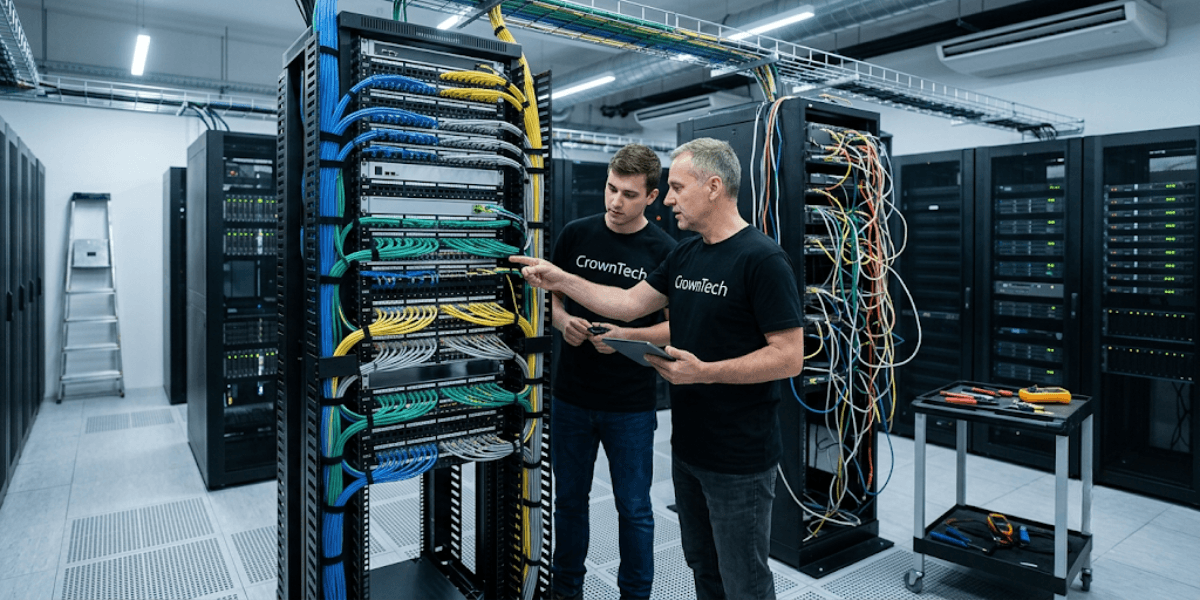
Planning an office relocation is a massive undertaking. Between floor plan decisions, configuring your desk, or coordinating with vendors, it's easy to forget that your most important business resource is your IT network. Yet the decisions you make about your cabling infrastructure will directly determine your business's performance on day one and for years to come, even before you unpack a single box.
The two terms "network cabling" and "structured cabling" are frequently used interchangeably when evaluating network cabling services for a new office. They are not the same thing, and confusing them during an office move can result in costly IT headaches, extended downtime, and a tangle of wires that becomes impossible to manage.
Here's the clearest distinction
- The physical cable, that is, the wires themselves, is known as network cabling.
- Those wires are organized, standardized, and, over the long term, easy to use, scale, and maintain, and they are a structured cabling system.
For Canadian businesses, a properly structured cabling services deployment eliminates the “spaghetti wiring” issue, which is common with ad hoc networks. It provides greater reliability, availability, and scalability for future growth and technology upgrades. An office IT relocation is the single best opportunity to get this right, and CrownTECH has spent over 25 years helping Ontario businesses do exactly that.
In Simple Terms: What is Traditional Network Cabling?
➣ The Analogy
Imagine putting extension cords into wall sockets every time you purchase a new appliance. It's like that with traditional network cabling. It addresses a current need but soon becomes an impossible tangle of devices as more are added.
➣ The Definition
The traditional network cabling is a point-to-point type of loose wiring. The hardware (servers, switches, and desktop PCs) is directly coupled to each other, with no centralized or standard design. No master plan, no designated infrastructure pathway, and no built-in organization.
Key Traits of Traditional Network Cabling
1. Ad-Hoc Setup
As a company expands, cables are added on as needed without a guiding architecture. By the time you're 50, you'll have a ceiling's worth of unlabeled wires connecting the five people you started with.
2. Hard to Trace
When a single line fails, IT teams must physically follow the wire through ceilings, under raised flooring, or inside walls. This results in lost hours and unnecessarily leaves employees offline.
3. Short-Term Focus
The up-front cost of ad hoc wiring is lower. That cost advantage will, however, rapidly get lost as soon as the system is out of control, needing a full replacement and not just a simple modification.
This is a problem that every business needs to encounter when it has no structured network with basic network cabling services. This is precisely why most growing businesses eventually search for structured cabling companies near me after outgrowing their original setup.
In Simple Terms: What is Structured Cabling?
➣ The Analogy
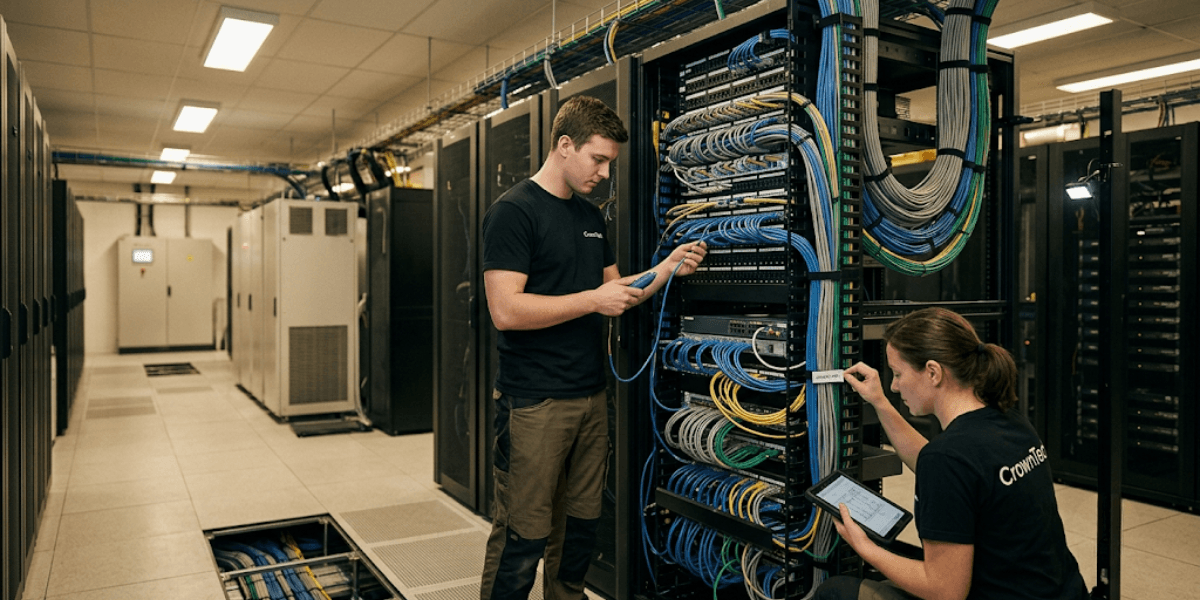
The structured cabling is equivalent to the main electrical or plumbing systems of a modern commercial building. Each wire is neatly tucked behind the walls to specific wire ports that return to one well-organized main panel. You always know where everything goes, and making changes is clean and straightforward.
➣ The Definition
Structured cabling is an extremely organized, standard, and tightly regulated cabling architecture based upon industry standards, namely ANSI/TIA/EIA cabling standards. It organizes an entire building's cabling into predictable, modular subsystems that work together as a unified whole.
Basic network cabling services just connect the devices, while structured cabling services are dedicated to creating a network infrastructure that will be manageable, scalable, and cost-effective in the long run.
Key Components of a Structured Cabling System
1. Patch Panels
The central "switchboard" is where all office data lines neatly terminate. A technician will not have to trace a wire from a desk to the ceiling, but he only needs to locate the corresponding port on the patch panel.
2. Main Equipment Room
A clear, temperature-controlled area for storing your racks, switches, core networking hardware, etc., organized, labelled, and fully accessible.
3. Horizontal Cabling
Secure cable pathways inside walls and overhead conduit runs that feed data drops at individual workstations. This is where fibre optic backbone cable is often deployed to provide high-speed, high-bandwidth backbone connectivity between equipment rooms and distribution points, which is an essential requirement for businesses with demanding, data-intensive applications and future bandwidth expansion needs.
4. The Core Benefit
Structured cabling is a plug-and-play architecture. Moving an employee to a new desk? A technician changes a single patch cable at the central panel, with no running a new 100-foot wire through the ceiling and no disruption to the rest of the office.
Quick Comparison: Network Cabling vs. Structured Cabling
Both systems use identical physical mediums, Cat6, Cat6A, or fibre optic backbone cable, but the approach to organization and long-term management is entirely different. The standard network cabling services are based on an unmapped direct setup, which might be suitable for a very small area with few devices.
Professional structured cabling services, however, provide a standardized design that quickly identifies and localizes faults, grows with employee numbers, and maintains infrastructure levels demanded in today's corporate working environments.
| Feature | Traditional Network Cabling | Structured Cabling System |
|---|---|---|
| Organization | Disorganized: likely to develop “spaghetti” wiring over time | Rigidly organized in dedicated racks and patch panels |
| Troubleshooting | Slow; has to be traced line by line | Fast: faults are immediately localized to a particular port |
| Scalability | Difficult: modifications require major disruption | Simple: open pathways allow for easy additions |
| Lifespan | Short: frequently replaced during office changes | Long: supports multi-generation hardware upgrades |
| Best Time to Install | On an urgent, localized basis | During an office IT relocation or office fit-out |
Why an Office IT Relocation is the Perfect Time to Choose Structured Cabling
1. The Blank Slate Advantage
When moving into a new commercial space, walls are often open, server rooms are empty, and no employees are yet sitting at desks waiting for connectivity. This is the window. When you hire commercial network cabling contractors and lock in your structured cabling services before furniture arrives, and employees begin to move in, it will be significantly cheaper and less disruptive compared to retrofitting when the office is in use.
Once employees are working, any cabling work means noise, access interruptions, and operational downtime costs that compound quickly across any business environment.
2. Downtime Prevention
Inheriting a chaotic legacy cable system from a previous tenant and trying to fix it after you've moved in is a guaranteed path to extended operational downtime. Each hour you have to wait without the ability to access systems and the internet costs you revenue and productivity. Beginning with a clean, structured layout eliminates this risk from day one.
3. Clean Out the Old
A relocation provides the opportunity to audit and remove abandoned, outdated wiring left behind by previous tenants. It's not only a housekeeping thing; safe, correct cable removal of any out-of-date wiring will ensure that your new office is code-compliant and, more importantly, fire-safe. In commercial buildings throughout Canada, abandoned cables in ceiling spaces are a known fire hazard.
4. Future-Proofing Your Investment
Structured pathways built today will support whatever your business requires tomorrow. For 50 to 200 people, your physical cabling infrastructure is already in place. No matter how your team transitions to a more dense hybrid model, or how you add IoT-based security systems to the mix, it will all still fit without tearing up walls and active operations.
Businesses that include structured cabling services in their IT office relocation checklist from the very beginning consistently report smoother transitions, lower long-term IT costs, and fewer network disruptions in their first year at a new location.
How CrownTECH Streamlines Your Infrastructure Relocation

➣ Beyond General Movers
General movers deal with IT gear as they would with furniture. CrownTECH treats your network as mission-critical infrastructure because it is essential. We provide over 25 years of experience and 1,000+ successful customer relocations throughout the GTA and are one of Ontario's most trusted structured cabling and IT relocation companies. This commitment translates to a seamless handoff without loss of productivity, time, or operational efficiency, every time.
Integration with IT Relocation Services
Structured cabling services installation isn't a task bolted onto a move as an afterthought; it's woven seamlessly into our comprehensive office relocation process.
- Pre-Move Assessments: We create the best structured data drop layout before pulling a single cable. All workstations, equipment rooms, and points of network access are planned with no surprises on move day.
- Conduit and Pathways: Overhead cable baskets and wall conduit runs are cleaned before hardware is moved. This ensures wires never lie loose on floors or run exposed across open ceiling tiles.
- Hardware Integration: Servers and switches are unpacked, installed in a structured framework, and neatly patched in, ready for your employees the moment they arrive.
This end-to-end approach reflects exactly what a professional IT office relocation checklist should look like: every dependency mapped, every cable tested, and every connection verified before go-live. There is no guesswork, no last-minute troubleshooting, and no scrambling on day one.
➣ The Result
Your employees report to work on Monday morning, your workstation is working, the network is stable, and you have a clean and documented cabling layout that your IT team can reference. No mystery wires. No unidentified drops.
Conclusion
Your new office is a chance to build the IT infrastructure your business actually needs instead of managing the chaotic legacy of what came before. Dragging unorganized, ad-hoc cabling into a clean commercial space is a problem you will be solving indefinitely.
Investing in professional structured cabling services and proper commercial network cabling when you move your office is an investment in the uptime of your business operations, making troubleshooting easier and scaling your IT infrastructure without stress.
From the fibre optic backbone cable used on high bandwidth backbone runs to a complete structured layout for a 200-person office, to a detailed IT office relocation checklist to coordinate all the moving parts, and the right partner can make all the difference between a smoother process and weeks of IT firefighting.
Planning an office relocation in Ontario or the GTA? Stop searching for structured cabling companies near me and go straight to the specialists. Contact us today and build a network that's ready before your team arrives.
Book Your Free Relocation Consultation
Contact us today to request a free consultation and secure a zero-data-loss, interruption-free transition.
Request Free Consultation →