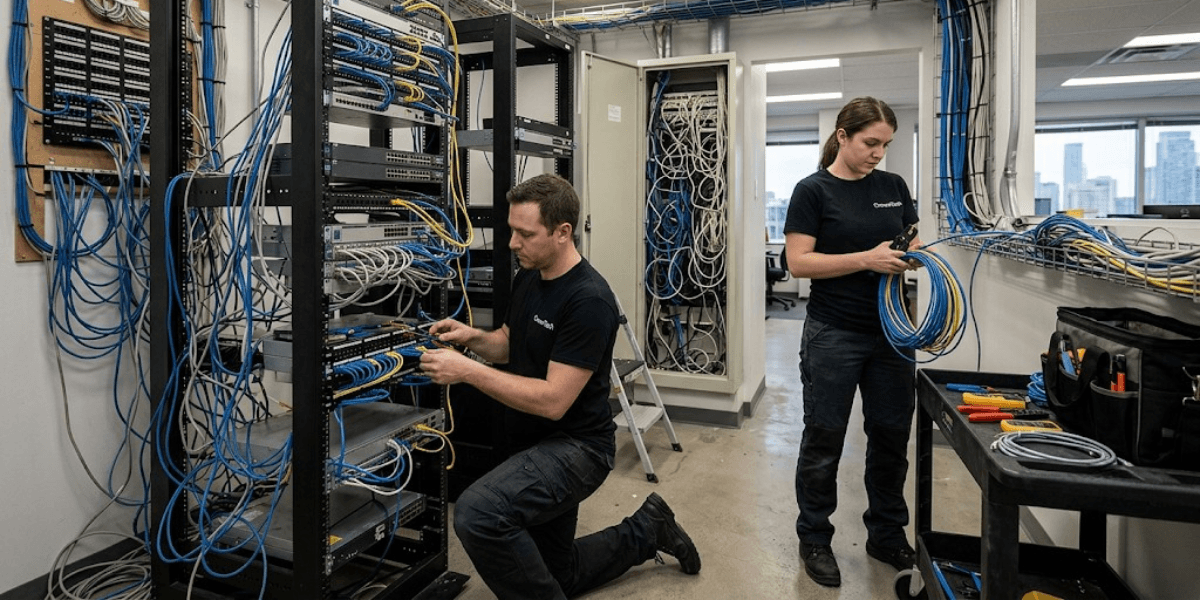
Toronto businesses are spending more time on cloud software, high-speed fibre internet, and advanced hardware, yet many of them still struggle with sluggish networks, dropped calls, and unexplained connectivity failures. The demands on corporate network cabling have never been higher, and when physical cabling is outdated or poorly installed, no amount of digital investment will deliver the performance your team expects.
The solution is structured cabling. A structured cabling system is a smart, organized telecommunications system built around TIA/EIA standards using planned cables, connectors, and pathways that support multiple hardware types and scale with your business.
As a result, the shift to hybrid office setups has pushed bandwidth demand to new heights across high-density commercial spaces in Toronto, Mississauga, Markham, and Vaughan. Businesses exploring structured cabling Toronto solutions are recognizing that legacy infrastructure is their biggest performance barrier, and Ontario's strict low-voltage compliance standards make a professional upgrade both an operational and regulatory necessity.
Upgrading your structured cabling is a direct investment in business continuity, operational speed, and future scalability. Here are six clear signs your Toronto business is overdue for one.
6 Key Signs Your Toronto Business Needs a Structured Cabling Upgrade
Sign 1: Frequent Network Outages, Latency, & Dropped Calls
➥ The Problem
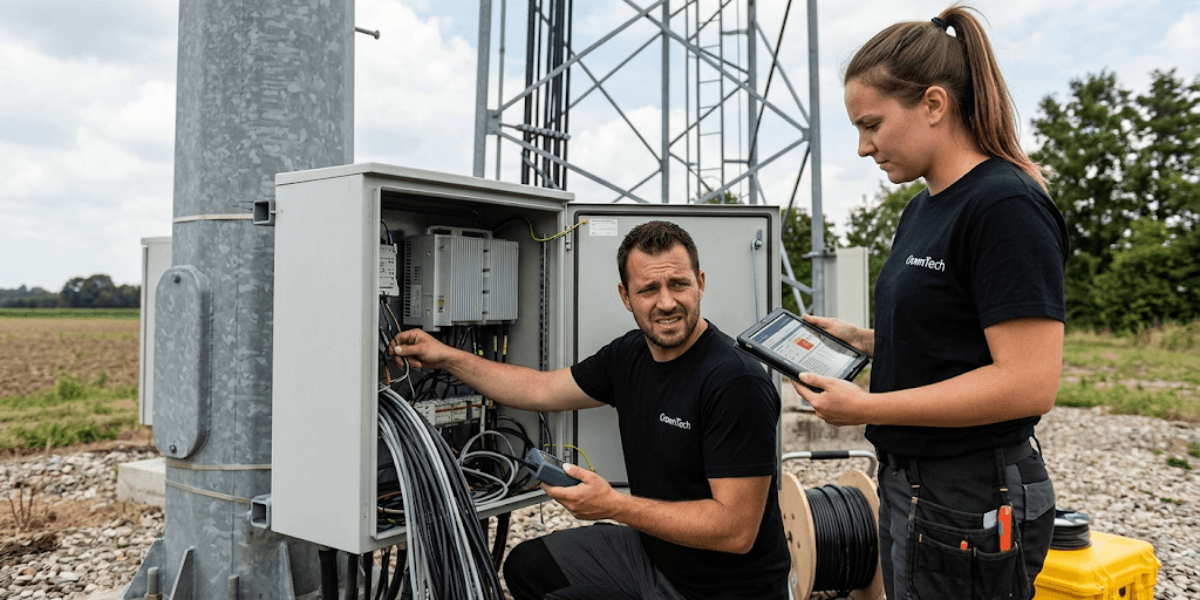
If, on a regular basis, your team encounters video meetings on Zoom or Microsoft Teams freezing in the middle of sentences, the audio dropping during VoIP calls, or frequent high packet loss at peak operational times, the problem might not lie with your internet plan; it could be due to your cable infrastructure.
➥ The Cause
Although it's not a well-known fact, enterprise network instability can often be caused by the degradation of physical wires. Over time, insulation can degrade, connectors can begin to oxidize, and cables may become susceptible to electromagnetic interference (EMI) from other appliances and office systems nearby, such as lighting systems, HVAC systems, and other office equipment. Another common issue is signal crosstalk, or when electrical signals from nearby cables interfere with one another, particularly in older copper wiring installations with dense cabling.
➥ Business Impact
Downtime is one of the most devastating costs for businesses and is among the first to suffer when there's an unforeseen issue that causes a network to go down. It causes loss of productivity and can also impact client relationships, compromise cloud-sync data integrity, and increase IT support costs if the outages occur often. You can address all these issues before you reach the network software layer if you can ensure the physical layer is reliable.
Sign 2: Legacy Cabling (Cat5 or Older) Bottlenecking Internet Speeds
➥ The Problem
Many Toronto businesses have upgraded to gigabit fibre internet, paying for speeds of 1 Gbps or higher only to find that individual workstations top out at 100 Mbps. The router, the ISP, and the switches may all be performing correctly. The cable itself is the limiting factor.
➥ The Cause
Legacy Cat5 cables were designed for a time when network demands were much lower. They simply can't handle the gigabit speeds we expect today, especially over typical office distances in real-world scenarios. This limitation puts a cap on performance, no matter how much you try to optimize other parts of the system. Fortunately, a professionally structured cabling installation can tackle this issue right at the physical layer.
The following comparison clarifies what each cable generation actually supports:
| Cable Type | Max Bandwidth / Speed | Max Distance | Best Use Case |
|---|---|---|---|
| Cat5 / Cat5e | 100 Mbps – 1 Gbps | 100m | Legacy systems (outdated) |
| Cat6 | Up to 1 Gbps (10 Gbps up to 37–55 m) | 100m | Standard office voice/data drops |
| Cat6a | 10 Gbps | 100m | Enterprise networks, high PoE, cloud apps |
| Fibre Optic | 10G to 100G+ | Kilometres | Backbone cabling, multi-floor connections |
For most businesses in Toronto that are running modern cloud applications and using collaborative tools, Cat6a should be the minimum standard when setting up new installations, and fibre optic cabling should be used for the backbone connections between floors or buildings.
Sign 3: Unorganized Server Room "Spaghetti Cabling" & Safety Hazards
➥ The Problem
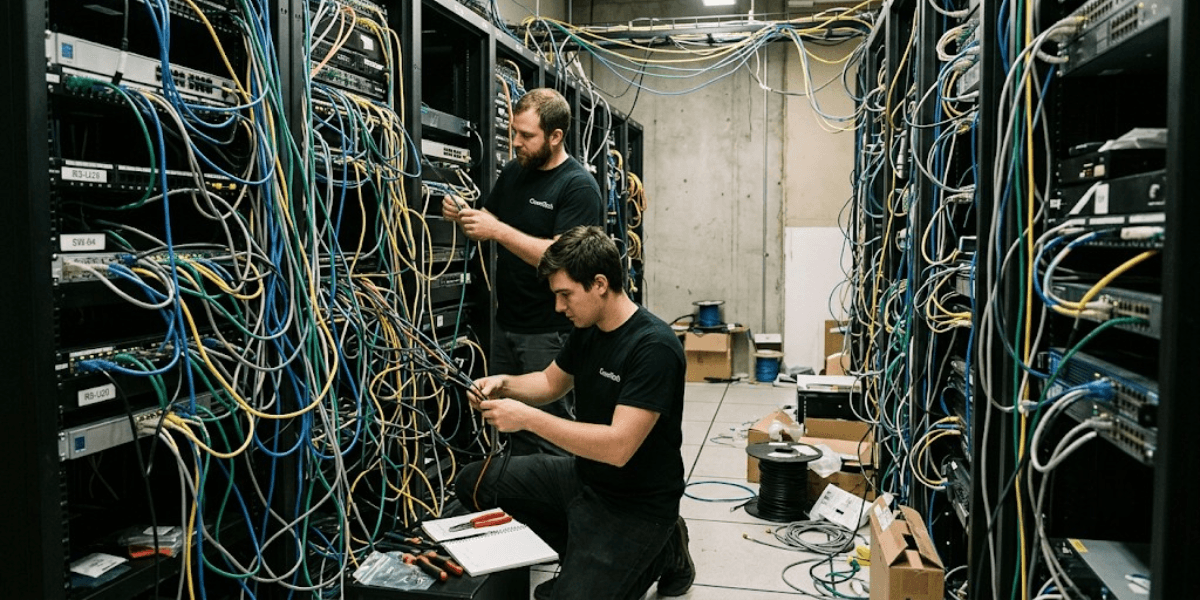
If you walk into a server room that hasn't been properly set up, you'll probably see a scene that's all too common: a jumble of tangled, unlabeled cables sprawling in every direction, hanging over equipment, and stacked in a way that makes no sense at all. This chaotic situation is known as "spaghetti cabling," and it brings with it serious operational and safety risks that any professional cabling company would be sure to address.
The Risks
- Restricted airflow: Messy, tightly packed cable bundles can block airflow around server racks and network equipment. This can cause equipment overheating and may shorten the life of your hardware.
- Accidental disconnections: Managing these wires is such a pain. When cables get all knotted аnd messy, even the simplest IT maintenance task turns into a total nightmare. Technicians might accidentally unplug something important, leading to unexpected downtime. A little better cable organization could really go a long way in making things smoother.
- Fire hazards and code violations: Cables that are improperly routed or left behind can create potential fire hazards and may not meet Ontario commercial building codes for low-voltage installations. Failing to meet these requirements also creates complications with insurance claims and lease agreements.
A professionally installed system of structured cabling features overhead basket trays, appropriate cable management panels, clear labelling, and proper documentation, thus removing these risks.
Sign 4: Inability to Support New Hardware & PoE Devices
➥ The Problem
These days, modern offices are leaning heavily on Power-over-Ethernet (PoE) technology. This nifty setup lets both data and electrical power flow through just one network cable. Devices such as smart TVs, IP security cameras, access control systems, and the latest Wi-Fi 6E/7 access points all rely on PoE, which means you can say goodbye to those extra power adapters.
➥ The Cause
Older cabling infrastructure typically has thinner wire gauge and can handle less power. PoE+ (IEEE 802.3at) and PoE++ (IEEE 802.3bt) equipment require greater power and cannot function over these older cabling infrastructures. PoE equipment designed for older cabling infrastructures is limited to single-digit or low double-digit wattage. Since PoE equipment draws power over the cabling, and that cabling has a limit, using higher wattage PoE equipment can cause degeneration of the cable's insulation.
When your business is planning an upgrade to its physical security, a refresh of its wireless infrastructure, or the installation of an AV system, you should first examine the existing cabling.
Sign 5: Office Expansion, Layout Reconfigurations, or Adding New Users

➥ The Problem
Growth leads to failure of the cabling infrastructure. If you are setting up a new team, rearranging your floor plan or fitting in an extra server rack, businesses that use outdated point-to-point systems always end up with the same result: a complete slowdown of the network, conflicts involving IP addresses, or a full network crash.
➥ The Cause
Rigid, outdated wiring setups aren’t built to keep up with a growing business. Adding new workstations to an already busy network without proper capacity planning can put too much strain on the existing infrastructure. Without clear pathways, overhead basket trays, and well-organized cable runs, even a simple expansion can quickly turn into a major headache instead of a smooth step forward.
A structured cabling system designed to TIA/EIA standards is built with future growth in mind from the very beginning. If your organization expects to add more employees or make major changes to its floor plan, upgrading your corporate network cabling before the expansion can help prevent unnecessary disruptions later. That way, future moves, additions, and changes are much easier to manage without interrupting everyday operations.
Sign 6: Preparing for an IT Relocation or Office Move in the GTA
➥ The Problem
Office relocations are one of the highest-risk periods for IT infrastructure. Businesses moving into new spaces, particularly in GTA commercial towers or repurposed industrial buildings, frequently inherit legacy cabling left behind by previous tenants. That inherited infrastructure may include abandoned cables, unlabelled runs, non-compliant installations, and cabling that predates current performance standards by a decade or more.
➥ The Solution
Before moving in, commission a professional infrastructure audit from a certified structured cabling Toronto provider. A professional audit can help you find existing cable runs, identify outdated, abandoned, or non-compliant cabling, and plan any necessary corrections before installing your equipment.
A proper structured cabling installation should also include safely removing old cables, followed by complete testing and certification once the work is finished. This gives your new workspace a clean and reliable foundation instead of leaving you with someone else’s cabling problems. It’s an easy step to overlook when planning a move, but taking care of it upfront can save you from plenty of headaches later.
Why Choose CrownTECH for Your Toronto Cabling Upgrade?
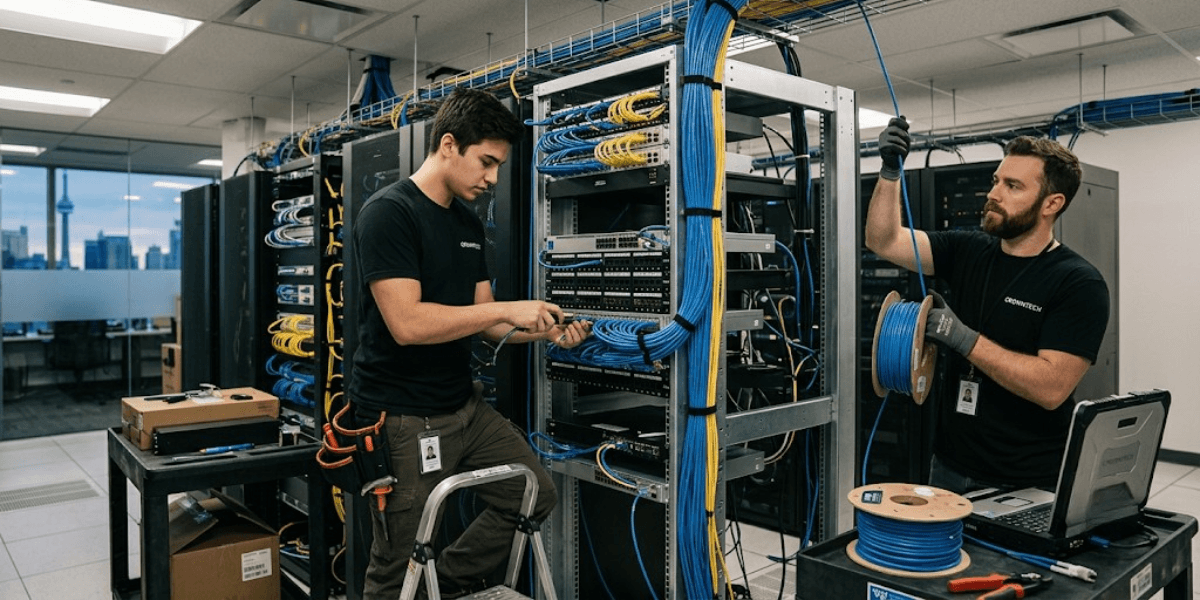
CrownTECH is a certified low-voltage and structured cabling specialist and one of the most experienced cabling companies serving businesses across Toronto, the GTA, and nationally across Canada. As a trusted structured cabling Toronto partner, we bring the expertise, certification, and local knowledge needed for your project to be completed to the highest standard. When your network performance is non-negotiable, selecting the right partner for your corporate network cabling project makes all the difference.
➥25+ Years of Enterprise IT Infrastructure Expertise
We have more than twenty-five years' experience in enterprise IT infrastructure and therefore possess a level of practical knowledge that neither general contractors nor IT generalists can equal. Our team has carried out structured cabling projects in commercial offices, healthcare facilities, financial institutions, and other multi-site enterprise environments.
➥ Interdependency Mapping
Before any cable is installed, we carry out a full pre-installation map of all the devices, switches, servers, and business-critical applications. This procedure removes any network conflicts when the system is switched over and makes sure that the installed system functions precisely as it was designed from the very first day.
➥ Zero Data Loss & Minimal Downtime Cutover
A structured cabling installation doesn’t have to interrupt your day-to-day business. We can carry out the work during weekends or outside regular business hours, helping your team stay fully operational while the project is underway.
End-to-End Infrastructure Services
Our full-service offering covers every phase of a structured cabling project:
- Certified Cat6/Cat6a and Fibre Optic Installation
- Safe Cable Removal & Reconfiguration (decommissioning legacy lines)
- Overhead & Wall Conduit Installation
- Server Rack & Cable Management Integration
- Post-Installation Testing, Certification & Full Labelling Documentation
Conclusion
Old cabling shouldn't be standing in the way of your business. Whatever the network performance issue is, whatever calls are dropped, and whatever hardware deployments fail, there is always a root cause, and in many businesses in Toronto, that root cause is transmitted through the walls.
A modern structured cabling system is the foundation of a reliable and scalable business network. It helps your cloud applications run at the speeds they’re designed for, keeps your hardware working properly, and makes it easier for your IT team to manage everything without dealing with tangled or outdated cabling.
Whether you’re planning a complete structured cabling installation, cleaning up a server room, or arranging an infrastructure audit before a move, choosing an experienced cabling company helps ensure the work is done to certified standards rather than being patched up over time.
Contact us today to book an infrastructure assessment and take the first step towards a network your Toronto business can actually rely on.
Book Your Free Infrastructure Assessment
Contact us today to book an infrastructure assessment and take the first step towards a network your Toronto business can actually rely on.
Schedule Infrastructure Audit →